
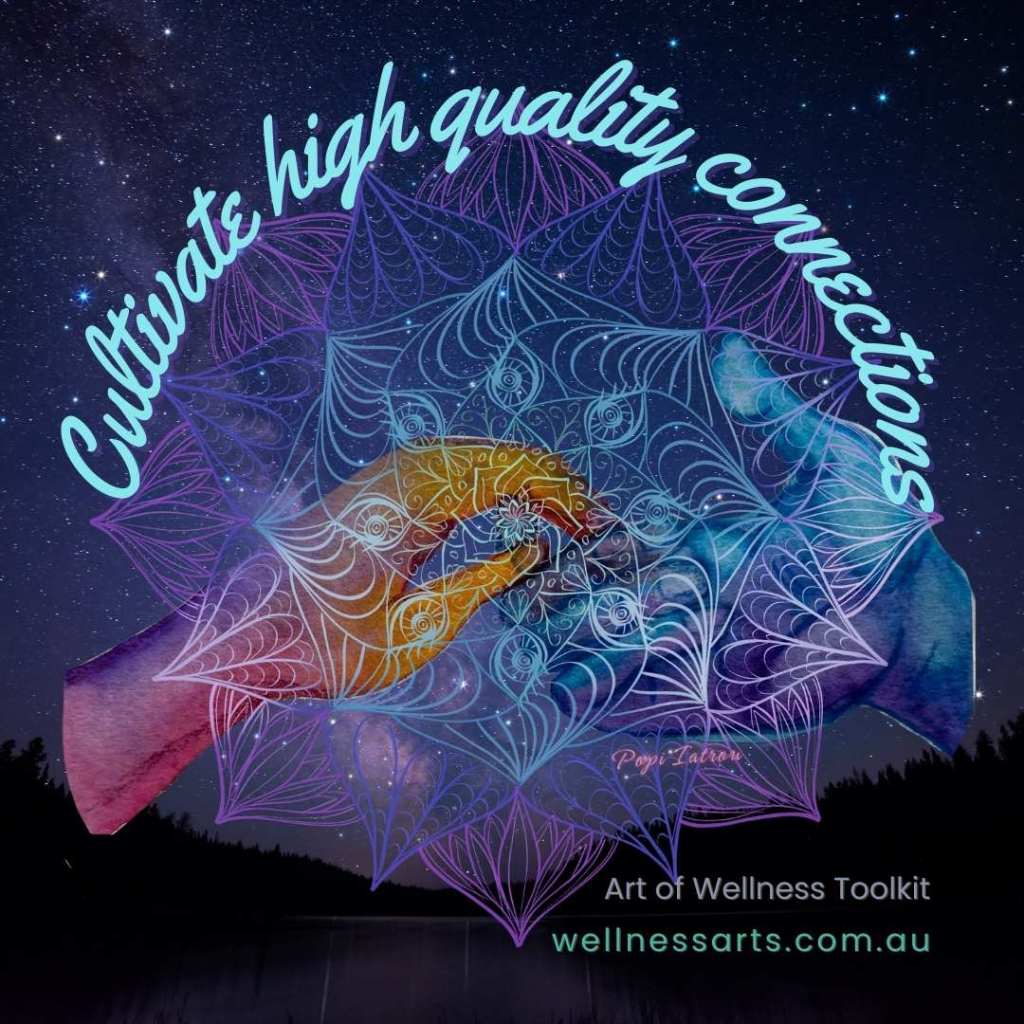
Tool 4.1 from The Art of Wellness Toolkit: High-Quality Connections
There’s a theme that has been popping up in my therapy room quite a lot lately. Clients from very different backgrounds, ages and lifestyles are all saying some version of the same thing:
“I wish I had more meaningful social connection in my life.”
Not hundreds of acquaintances. Not another WhatsApp group that nobody replies to. Not a vague promise to “catch up soon.”
They are talking about real connection. Regular connection. People they actually see and speak with.
Modern life has created a strange paradox. We are more digitally connected than any generation in history, yet many people feel socially undernourished. We can watch the lives of hundreds of people on Instagram while sitting alone on the couch in our trackpants wondering why everyone else appears to have a thriving social life.
Meanwhile, the research keeps reminding us of something our bodies already know. Social connection is not just a pleasant lifestyle bonus. It is essential for mental health, cognitive health and even longevity. Studies link meaningful relationships with lower depression, lower anxiety, reduced risk of dementia and longer life expectancy.
In other words, friendship is not frivolous. It is preventative medicine.
Humans evolved in tribes and communities. Our nervous systems developed in environments where people cooked together, worked together, raised children together and probably complained about each other around the fire.
We are wired for belonging. So when connection drops away, something inside us notices.
The Effort Problem
One of the realities of adulthood is that friendships rarely happen automatically anymore.
At school and university we were surrounded by people our own age every day. Relationships formed naturally through proximity. Later in life, people move cities, careers get busy, families expand, and suddenly maintaining friendships requires something uncomfortable.
Effort.
Someone has to send the message. Someone has to suggest the coffee. Someone has to say, “Do you want to come to this yoga class with me?”
This is often where the internal dialogue begins.
“What if they say no?”
“What if they’re busy?”
“What if I’m bothering them?”
That little voice can shut down a connection before it even begins.
I often encourage clients to gently experiment with being the one who reaches out. Not desperately, not constantly, but simply being willing to initiate from time to time. Most friendships survive on a rotating system of who organises the next catch-up.
Choosing Your People
The other side of the social equation is something many people learn the hard way. Not every relationship deserves equal investment.
Many clients realise they have poured enormous energy into friendships that feel one-sided. They organise the catch-ups, listen to the problems, send the supportive messages, and eventually notice that the effort is not reciprocated.
This is where the idea of high-quality connections becomes important.
We are not designed to maintain hundreds of close friendships. In fact, our brains are much happier with a small circle of meaningful relationships.
A few people who show up.
A few people who listen.
A few people who laugh with you when life becomes ridiculous.
That’s enough.
Over the years I have joined various social groups that genuinely feel like my tribe. Women’s circles, weekly yoga groups, gym classes, art societies and the occasional dance gathering. Each one creates opportunities for connection around shared interests. But I’m also careful not to overload my calendar. If I tried to attend everything every week I would need a social recovery day just to lie quietly in a dark room and drink tea.
Humans are social, but we are not built to maintain the social schedule of a cruise ship activities director. Quality beats quantity every time.
The Self-Worth Factor
Our sense of self-worth also plays a role in how we manage friendships. When we value ourselves, we tend to become more comfortable protecting our social energy. We recognise that we deserve relationships where effort flows in both directions.
When self-worth is shaky, we sometimes tolerate friendships that repeatedly leave us feeling small, drained or unappreciated. Learning to notice the difference between nourishing and draining relationships is an important life skill.
Your nervous system often knows before your mind does. Some people leave you feeling lighter.
Others leave you needing a nap. That’s useful information.
The Great Social Balancing Act
Finding meaningful connection in modern life can feel like a bit of a balancing act.
You have to make some effort without chasing people.
Stay open to new connections without overwhelming yourself.
Protect your time while still leaving space for community.
It’s not always neat or predictable. But when we do cultivate even a handful of authentic relationships, something shifts inside us. The nervous system settles. Life feels more supported. Challenges become easier to carry.
We remember that we are not meant to navigate everything alone. So perhaps the reflection this week is a simple one. Is there someone you could reach out to for a coffee, a walk, or a shared activity this week?
And just as importantly, are you investing your social energy in people who genuinely meet you halfway? Because in the end, meaningful connection is less about the number of friends we have and more about the quality of the few who truly matter.
And yes, it really is a bit of a balancing act.
Warmly,
Popi Iatrou
2 responses to “Why Meaningful Social Connection Is Essential for Mental Health and Longevity”
-
Thank you
-
You are most welcome dad.
-


2 thoughts on “Why Meaningful Social Connection Is Essential for Mental Health and Longevity”
-
Thank you
-
You are most welcome dad.
-


Leave a Reply