Looking at Energy Differently
There are times when people are doing everything they can to support their mental wellbeing, and yet something still feels off.
They are showing up, using strategies, and staying engaged in the process, but there can be a quiet sense that things feel heavier than they should.
It often gets described in simple terms.
A loss of energy.
A sense of feeling flat.
A feeling that something has shifted internally.
Many people describe it as having lost their mojo.
It’s Not Always About Motivation
When this happens, it is easy to assume that more effort is needed. That trying harder will bring things back into place.
In practice, this is often not the case.
What tends to be affected is not motivation, but energy, capacity, and rhythm. When the nervous system has been under sustained pressure—through stress, burnout, or ongoing health challenges—it makes sense that things don’t move in the same way they once did.
Pushing harder in that space can lead to further depletion rather than improvement.

A Shift in Focus
What can be more helpful is a shift in focus.
Instead of asking:
Why can’t I get back to where I was?
It can be more useful to ask:
What is happening with my energy right now?
And:
What supports me to feel a little more like myself?
This kind of questioning moves away from performance and towards awareness.
A Simple Way to Track Your Energy
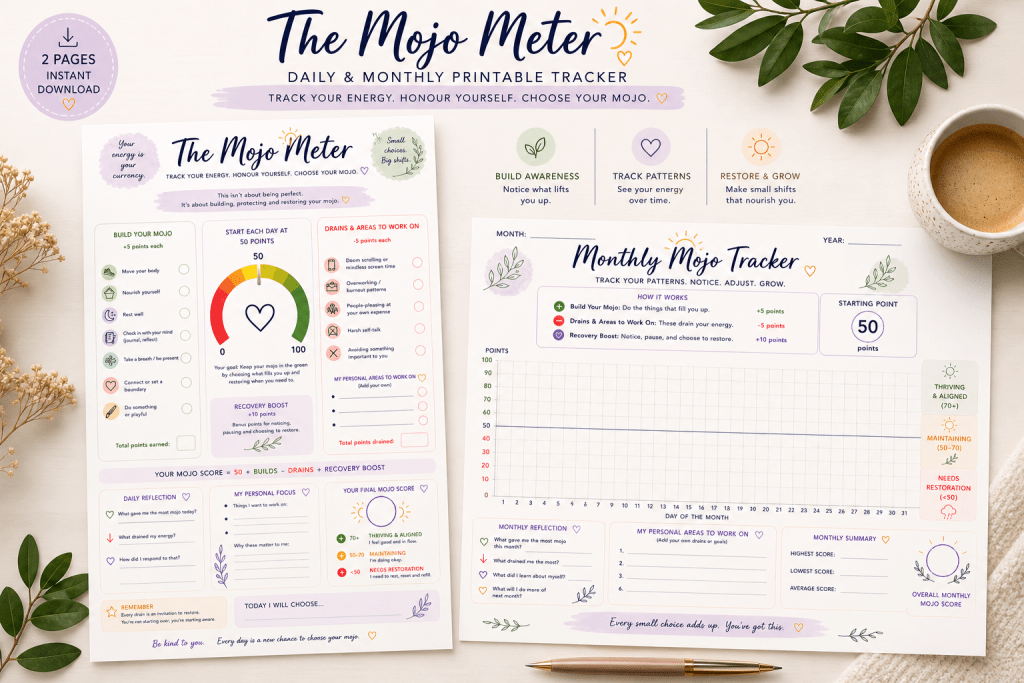
One approach that has emerged from this way of thinking is a simple tracking system focused on energy rather than behaviour.
It starts from a neutral point and builds awareness of three things across the day:
- what gives you a lift
- what takes something out of you
- what helps you restore
There is no expectation to get it right, and no ideal score to reach.
The value comes from noticing patterns over time and understanding how your energy moves in response to different situations, choices, and environments.

Working with Capacity
When people begin to track their energy in this way, something often shifts.
There is more clarity around what is actually sustainable.
There is less pressure to maintain a level of functioning that may not be realistic in the current moment.
And there is more room to make small adjustments that support regulation rather than push against it.
Small Changes, Real Impact
The changes that come from this kind of awareness are usually not dramatic.
They are small and consistent.
Taking a break earlier.
Stepping outside.
Saying no to something that would have previously been pushed through.
Adding in something that brings a sense of ease.
Over time, these small shifts can begin to restore a sense of rhythm.
A Practical Tool
To support this process, I have created a simple printable tool called the Mojo Meter, along with a Monthly Tracker to help you observe patterns over time.
It is designed to be flexible and adaptable, so it can be used in a way that fits your own pace and circumstances.
You can explore it here:
The Mojo Meter and Monthly Tracker
For Psychologists and Practitioners
For those working in clinical settings, this kind of tool can support conversations around pacing, capacity, and self-regulation, particularly with clients experiencing burnout, chronic stress, or ongoing health concerns.
It offers a simple structure that can be adapted to the individual, without introducing rigidity or performance-based pressure.
A Different Way Back to Yourself
When energy has shifted, it doesn’t always return through effort alone. Sometimes it requires a different kind of attention. A slower, more attuned way of noticing what supports you and what doesn’t.
Losing your sense of momentum does not mean it is gone for good. Sometimes it simply needs a different kind of support to find its way back.

- Hypnosis Through a Holistic Psychology Lens: More Than Just “Relaxation”
- Alcohol Doesn’t Create Joy. It Borrows It From Tomorrow.
- Discipline Is the Pathway to Freedom
- The Psychology of Integration: How Different Parts of Our Lives Become Whole
- Rediscovering the Power of Play for Creativity
Discover more from Wellness
Subscribe to get the latest posts sent to your email.