
The Forgotten Medicine for a Vibrant Life

When I recently completed the final paintings for the Wise Women Oracle project, I expected to feel excited about starting my next major body of work.
After all, creating the 38 original paintings had been one of the most rewarding creative experiences of my life. For many months, my focus had been on bringing the project to life—painting, refining, photographing, framing, writing, planning, and problem-solving. It was deeply meaningful work, but it also required discipline, commitment, and sustained concentration.
So, when the project was finally complete, I assumed I would be eager to begin the next collection.
Instead, something unexpected happened.
I found myself reaching for a cheap watercolour set, scraps of paper, old magazines, and an art journal. I wasn’t interested in creating another finished artwork. I wanted to experiment. I wanted to layer colours, cut images from magazines, scribble ideas, and make messy pages with no purpose other than the enjoyment of the process.
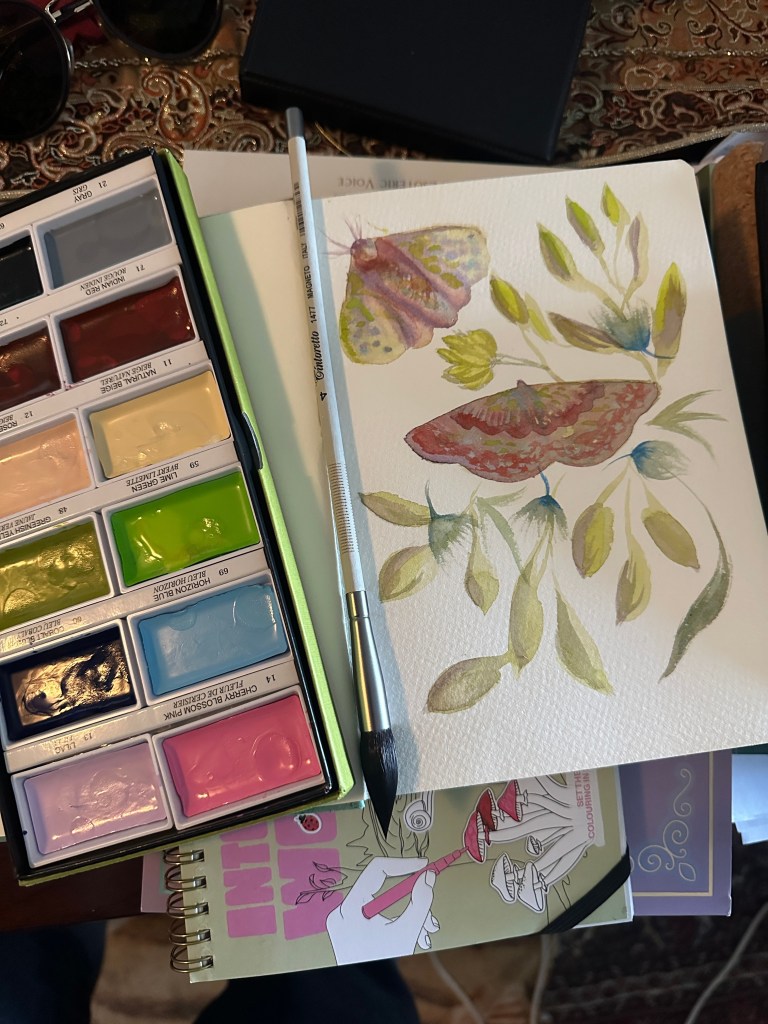
At first, part of me questioned this impulse. Shouldn’t I be working on my next exhibition piece Shouldn’t I be creating something useful? Shouldn’t I be making progress?
Then I began reading The Imagination Muscle by Albert Read, and something clicked.
The author suggests that imagination is much like a muscle. It doesn’t grow through pressure, perfectionism, or constantly striving for outcomes. It grows through use. Through curiosity. Through experimentation. Through play.
It reminded me of something I often tell my clients, but had temporarily forgotten myself. Play is not the opposite of growth. Play is one of the pathways to it.
When Did We Stop Playing?
If you watch young children, they are naturally driven to explore. They climb, build, create, imagine, experiment, pretend, and test the limits of what is possible. They are not concerned with mastery or productivity. They play because exploration itself is rewarding.
Somewhere along the way, many adults lose this capacity. Responsibilities increase. Achievement becomes more important. Hobbies become side hustles. Creativity becomes performance. Rest becomes something that must be earned.
Many of us become highly skilled at working, producing, caring for others, and meeting expectations, but we slowly forget how to engage in activities simply for the joy of discovery.
Yet play is not frivolous. It is one of the primary ways human beings learn, adapt, and grow throughout life.

The Psychology of Play
Research consistently shows that play supports physical, emotional, social, and cognitive development.
Play stimulates creativity, problem-solving, learning, and innovation. It helps build new neural pathways, strengthens emotional regulation, and improves resilience. It also supports healthy social connection and increases our ability to adapt to change.
The psychiatrist and play researcher Stuart Brown devoted much of his career to understanding the role of play in human development. His research suggests that play is not merely recreation. It is a biological necessity that supports wellbeing throughout the lifespan.
From a neuroscience perspective, novelty and exploration stimulate neuroplasticity—the brain’s ability to create new connections and adapt through experience. Every time we try something unfamiliar, we invite the brain to grow.
This is one reason play often feels energising. It awakens parts of us that routine alone cannot reach.
Beyond Productivity
Many of us have been conditioned to evaluate activities according to their usefulness.
Will this help me earn money?
Will it make me more successful?
Will it improve my skills?
Will it get me somewhere?
These questions are not inherently bad, but they can become limiting when they dominate every decision we make.
Not everything needs to lead somewhere. Some experiences are valuable simply because they expand us.
- A dance class.
- A new walking track.
- Learning a language.
- Trying watercolours.
- Joining a choir.
- Taking a pottery workshop.
- Travelling somewhere unfamiliar.
- Reading a book outside your usual interests.
These experiences may never become careers, businesses, or achievements. Yet they enrich our lives in ways that are difficult to measure.
Exploration broadens our perspective and introduces us to new ways of thinking, feeling, creating, and relating.
Why Play Matters More Than Ever
I suspect my recent desire to play with watercolours and art journalling emerged because my imagination needed room to breathe. After spending so much time working towards a specific outcome, I needed a space where there were no expectations, deadlines, or measures of success.
I needed a place where curiosity could lead the way.
The more I allowed myself to explore without an agenda, the more energised and inspired I felt. New ideas began to emerge naturally. Creative connections started forming that I could never have forced through effort alone.
It made me realise that some of the most important periods of growth in my life have not come from striving harder. They have come from allowing myself to play.
- Learning bellydance.
- Studying yoga.
- Returning to art.
- Creating the Wise Women Oracle.
- Recently completing Reiki Level 1 training after years of curiosity.
Each began with a simple willingness to explore something that interested me. Not because I knew where it would lead. But because I was curious enough to find out.
Inner Compass Check-In
Take a moment to reflect:
- What activities did I love as a child?
- When was the last time I did something simply for fun?
- Where has productivity replaced curiosity in my life?
- What have I been curious about but hesitant to explore?
- What might change if I gave myself permission to play again?
Creative Integration Practice
This week, choose one activity with no outcome attached. Not to become good at it. Not to turn it into a project. Not to share on social media. Simply to enjoy the experience.
- Paint
- Dance
- Garden
- Write
- Sing
- Collage
- Explore a new place
- Learn something completely unrelated to your goals
Approach it with the mindset of a curious child rather than a competent adult. Notice what happens.
Play and Grow Young
As we age, it is easy to believe that growth comes only through discipline, responsibility, and hard work. These qualities certainly matter. But so do wonder, curiosity, experimentation, and play.
Perhaps the invitation is not to become more serious. Perhaps it is to become more alive.
Because sometimes the next chapter of growth begins not with a plan, but with a willingness to play.
As I write this, my watercolours, scissors, glue stick, and art journal are spread across the table beside me. I have no idea where this playful exploration will lead, but for the first time in a long while, that feels perfectly okay.
Perhaps there is something in your life asking for the same freedom.
I’d love to know:
What activity helps you lose track of time and reconnect with a sense of wonder?
What have you been curious to try but haven’t yet given yourself permission to explore?
Leave a comment below or send me a message. I genuinely love hearing about the adventures, creative sparks, and unexpected paths unfolding in your lives.



Discover more from Wellness
Subscribe to get the latest posts sent to your email.

Leave a Comment